
Browse all sections
Your account & signing in
/dashboard/accountEveryone in Ida OS — staff and families alike — has an account page for their name, photo, and personal sign-in settings. This is separate from your studio or family record; it controls how you appear and how you log in.
Finding the sign-in page
Web dashboardOn the web, the Login button sits at the top of every page of the Ida OS site. On a computer it is in the top-right corner; on a phone it is the solid button right beside the menu — and if you open the menu, Login is the first item there too. Every page's footer also carries a Login link, so the sign-in page is never more than a tap away.
Two ways to sign in
By default you can sign in with an emailed one-time code: enter your email, receive an 8-digit code, and type it on the sign-in screen — no password to remember, and the email deliberately contains no sign-in link. If you would rather use a password, you can set one and both methods will keep working. On the web sign-in page, the eye icon at the end of the password field shows or hides what you typed, and switching between Password and 'Email me a code' keeps the email address you entered — no retyping.
Note. Invitation and password-reset links open a quick confirmation page first — press Continue to proceed. That extra click keeps email security scanners from using up your link before you do. A used or expired link shows a clear 'link expired' page with a button to your studio's login, where you can request a fresh one.
Your name in Messages
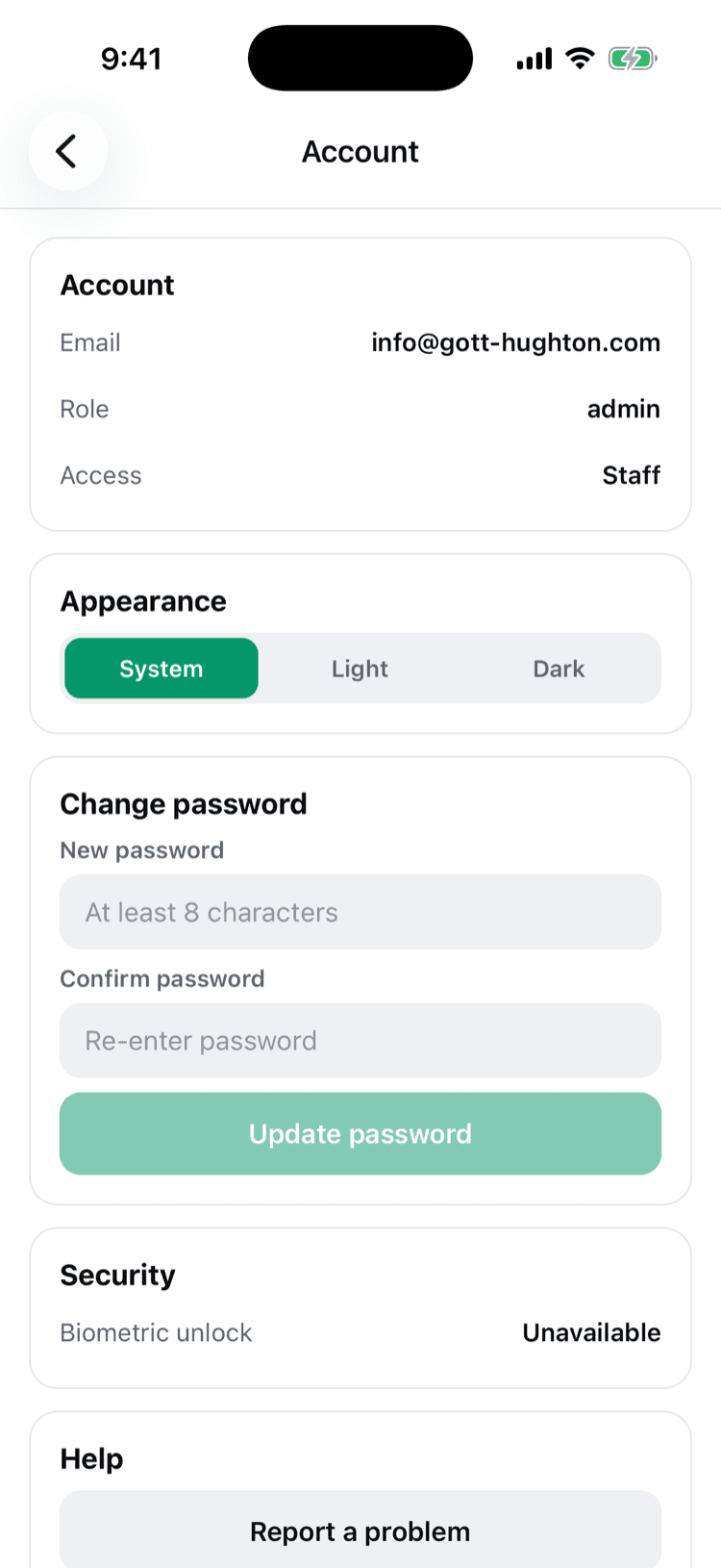
Your account has a name field — this is how you appear on messages you send, including the studio's line to Ida. Set it on the web from Account, or in the iPhone app on the Account tab. If you have not set a name yet, staff messages show your studio's name instead of a generic label.
- 1Open Account — on the web, from the sidebar or Settings; in the app, the Account tab.
- 2Enter the name people should see, then save.
Set or change your password
- 1Open your account page from the navigation.
- 2In the password section, enter a new password.
- 3Save. From now on you can sign in with either your password or an emailed code.
See everywhere you are signed in
Your account page — on the web and in the iPhone app — also lists your signed-in devices: every place your account is currently signed in, whether a web browser or a phone with the Ida app. Each one shows a plain-language label like 'Chrome on Mac' or 'Ida app on iPhone', when it was last active, and its approximate location, and the one you are reading from is marked 'This device'.
If you spot a device you do not recognize — or you stayed signed in on a shared computer — press Sign out beside it to end that session, or 'Sign out of all other devices' to keep only the one in your hands. A device that was active moments ago can take a short while to notice it has been signed out.
Note. Choosing Sign out — on the web or in the app — only signs out the device you are on; your other devices stay signed in until you sign them out from this list.
Light or dark mode
Ida OS follows your device's appearance by default, and you can override it. On the web, click your name at the bottom of the sidebar and choose Light mode or Dark mode. In the mobile app, the Account tab has an Appearance setting with System, Light, and Dark options.
One exception: the sign-in screen — on the web and in the iPhone app — always uses the light look, whatever your device or appearance setting says. Your appearance choice applies everywhere else once you are signed in.
Face ID on the iPhone app
iPhone appOn the app, the Account tab also holds a Security section where you can turn on biometric unlock. Once enabled, reopening the app asks for Face ID (or Touch ID) instead of your password — faster, and your account stays protected if someone else picks up your phone.