
Browse all sections
The dashboard
/dashboardThe dashboard is the first screen you see after signing in, and it is the home base you return to from anywhere in Ida OS. What it shows depends on who you are: studio staff see an operational overview of the whole school, while families see a personal summary of their own students and account.
You never need to configure the dashboard — it assembles itself from your live data and updates as families enrol, classes fill, and payments come in.
If you run the studio
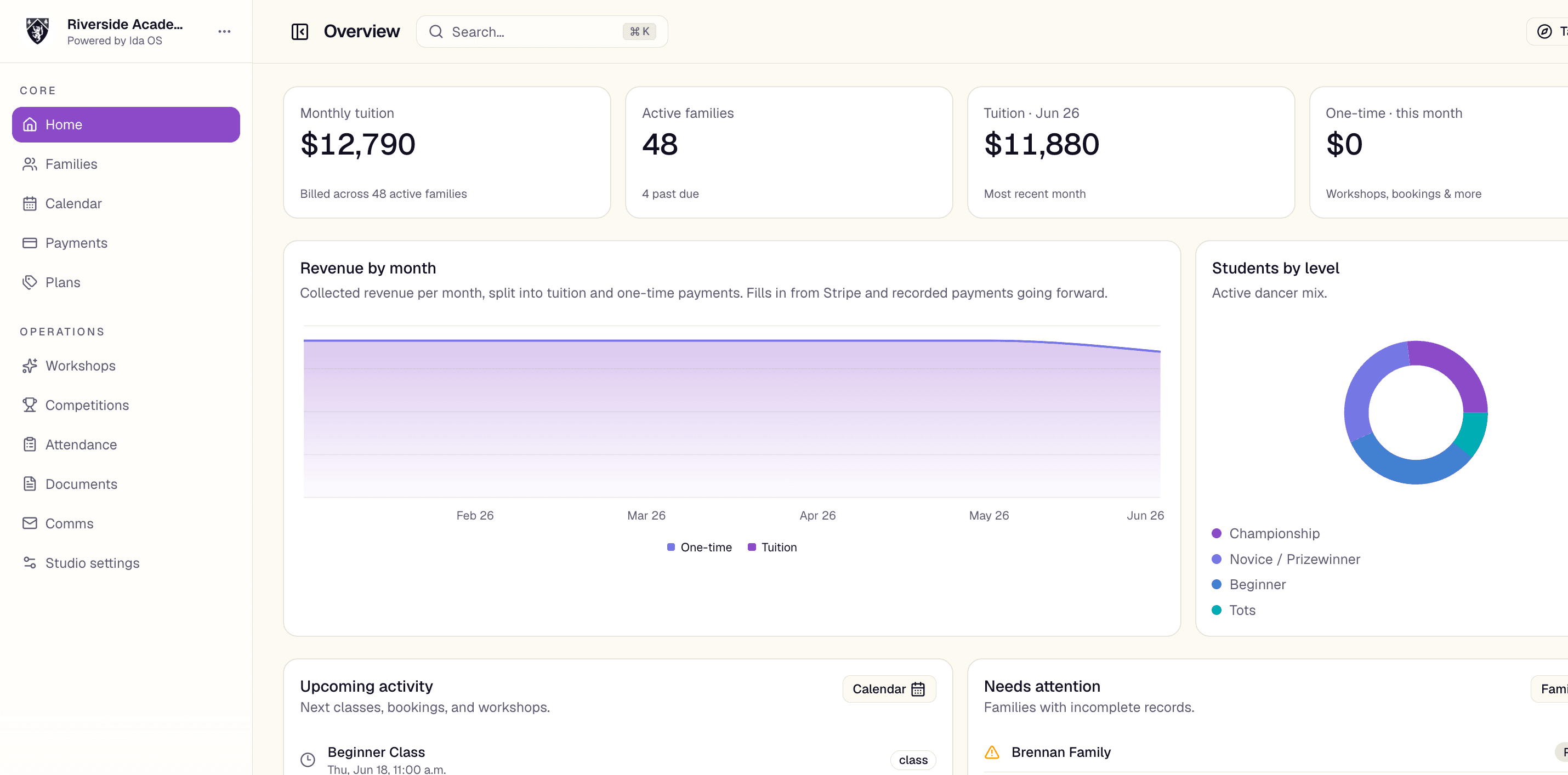
Staff land on an operations overview. Across the top you will find four summary cards — monthly tuition revenue (with how much of it has already been collected this month), active families, students across all levels, and everything collected so far this month (with the pre-tax and tax split when tax applies). Use these as your daily pulse check.
Below the cards, a 'Revenue by month' chart shows what you have collected over time — split into tuition and one-time payments — and a 'Students by level' chart shows your dancer mix — click any slice of that chart, or any level in its legend, and you land on the roster's Students view already filtered to that level's active dancers. Further down, 'Upcoming activity' lists the next handful of classes, bookings, and workshops, each wearing a chip in your calendar's color for that event type and under the name your studio gives it, and 'Needs attention' surfaces live work waiting on you — pending booking requests and suggested times you can approve or decline right there, plus your open charges — anything past its due date first, then the newest — each listed with the family, what the charge is for, its status, any due date, and the amount — click a family to jump straight to Payments. The panel's Requests button opens the Calendar's Booking Requests tab when you want the full queue. At the bottom, 'Recent payments' lists the latest payments in your ledger, each with a color-coded type chip — the same colors the Payments page uses — so you can tell tuition from workshops and bookings at a glance. Last is a Birthdays card: dancers with a birthday today or in the next 7 days — name, the age they are turning, and Today / Tomorrow / the weekday — click a dancer to open their family, or open Calendar on the card for a month view of every birthday on the roster. It uses birthdates already on the roster, and you can hide it from Settings → Customizations → Birthdays on Home.
Tip. The 'Needs attention' panel is for active work — booking requests waiting on approval and open charges — not incomplete family records. When it says nothing is waiting, there are no pending approvals and no open charges.
Fold sidebar sections away
Web dashboardOn a larger screen, the sidebar's section headings double as buttons: click one to fold that group of pages away, and click it again to bring it back. Ida remembers which sections you keep folded on that device. Work waiting inside a folded section still reaches you — its heading picks up a small count when something in it needs attention, like unread messages, booking requests, shop orders to prepare, or a family's open charges and registration fee — and opening a page that lives in a folded section unfolds it, so you can always see where you are.
On your phone's browser
Web dashboardOn a phone, the web dashboard gets around the same way the iPhone app does. A tab bar runs along the bottom of the screen — Home and Calendar, a round Ask Ida button in the middle, then Families for staff or Payments for families, and More. More opens a full screen with your studio's name and logo at the top and everything else one tap away, grouped into labeled sections — for studio owners that means money, running the studio, new students, and settings, while instructors and families see the sections that apply to them — and it is also where Notifications, your account page, Report a problem, and Sign out live. For staff, if your studio's setup checklist is still open, the Finish setup reminder sits as a slim bar above the page title — tap it to see what is left. On a larger screen nothing moves: the sidebar navigation stays as it is.
On the iPhone app
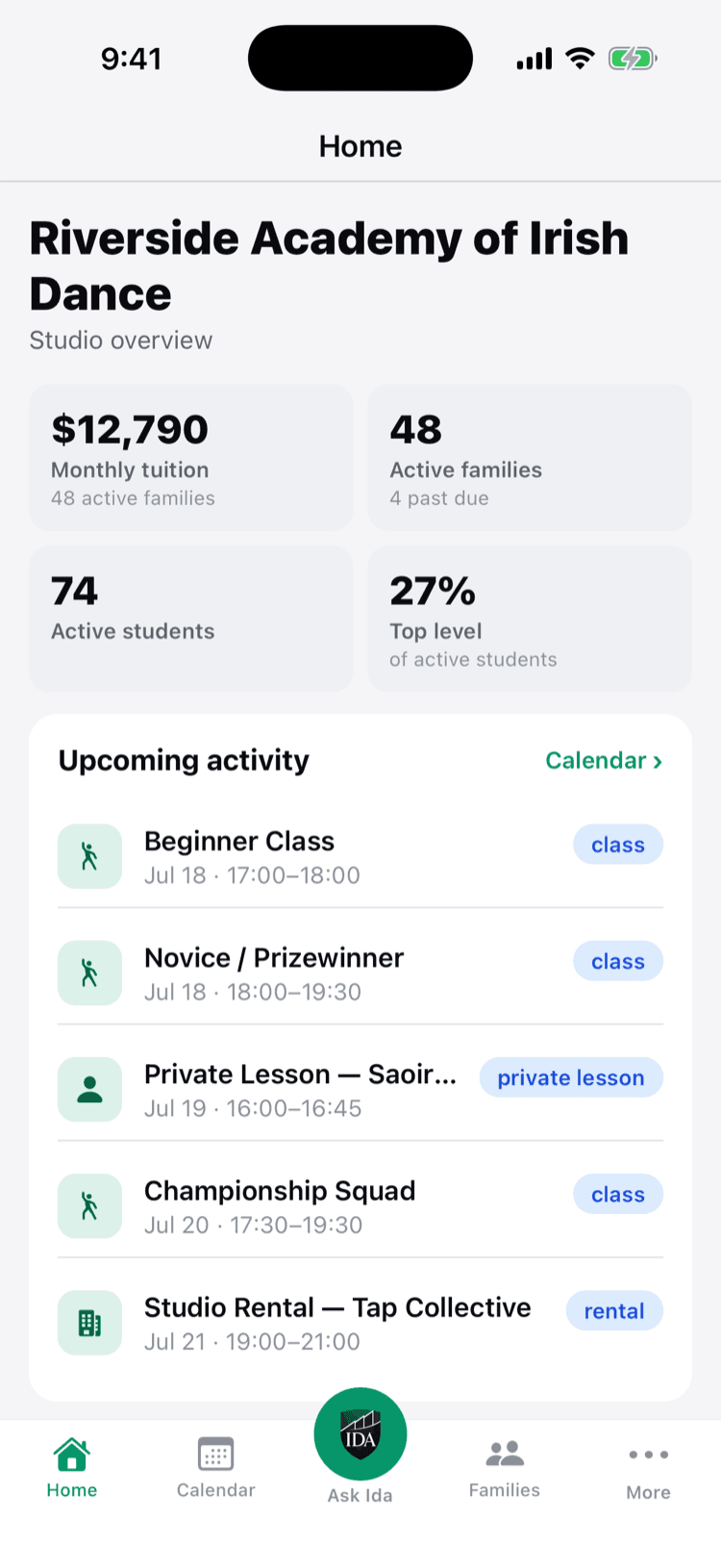
iPhone appThe app opens on the Home tab with the same pulse check: your stat cards (admins see monthly tuition, active families, active students, and everything collected so far this month — with the pre-tax and tax split when tax applies; instructors see the family and student counts without the money), an Upcoming activity list of the next classes and bookings, a Needs attention card for pending booking requests — plus the open charges for admins — tap Booking requests to open Calendar, or any listed charge to jump straight to Payments — and a Birthdays card at the bottom for dancers with a birthday today or in the next 7 days. Tap a name to open their family, or tap Calendar on the card for a month view of every birthday on the roster. You can hide Birthdays from Studio settings → Customizations → Birthdays on Home. Families open on a Home of their own: your family card and a Due now card up top — the amount that needs you now, with a short line that says All clear, what date something is due, or that charges are only coming up — then the same Upcoming list of everything your household is signed up for next — weekly classes and practices your dancers have joined, workshops, camps, and private lessons alike — and your students. The tab bar along the bottom — Home, Calendar, Ask Ida, then Families for staff or Payments for families, and More — is how you move around the app; for staff, the Calendar tab wears a badge with the number of requests waiting on approval, and for families, the Payments tab wears one counting what needs you now — overdue charges, anything due today, undated charges, a failed payment, plus the registration fee when it is owed and not yet billed as a charge; a bill that is not due yet waits on Payments without adding to the badge. Everything else lives under More, a full screen with your studio's name and logo at the top and each tool one tap away, grouped into labeled sections: for admins, money (payments and tuition plans), running the studio (attendance, comms, workshops, competitions, documents), the shop when yours is turned on, new students, and settings — instructors see running the studio and settings, since the money and new-student tools are admin territory; for families, your own profile and registration, the studio's shop (when it is on), documents, workshops, and competitions, and your account. Every screen you open from More has a back button in the top corner to return you to the menu.