
Browse all sections
Ida AI assistant
Ida is the built-in AI assistant, available to anyone attached to a studio. It answers questions grounded in your studio's own documents and records, so the answers reflect how your studio actually works — not generic advice. For studio admins, Ida can also make changes to your roster and your class schedule — always showing you exactly what it is about to save and waiting for your go-ahead first.
For staff
Staff get the full assistant, which can draw on your records and the documents you have uploaded to help answer day-to-day questions.
Ida's answers follow the same role boundaries as the rest of Ida OS: admins can ask about anything, including revenue, tuition, and payments, while an instructor asking about a family gets the roster, schedule, and attendance side of the answer — never tuition amounts, billing status, or the studio's money.
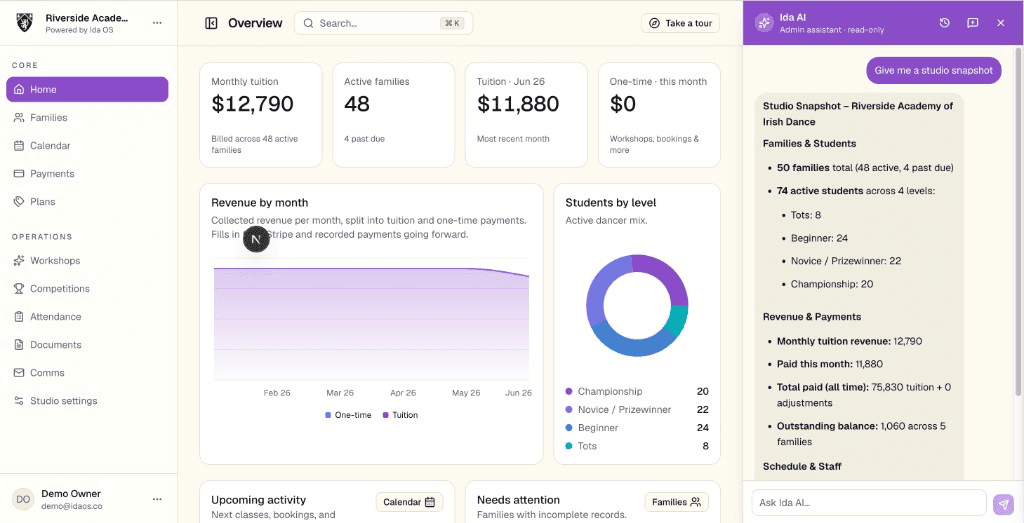
On the web, Ida sits at the top of your sidebar: click the Ida AI button and the chat opens in a panel docked beside your menu, sliding the page over rather than covering it, so you can keep working with the conversation alongside. Click the button again to put it away.
Ask Ida to make changes
Admins can do more than ask questions. Tell Ida to add a family — 'Add a family named Walsh with parent Sam and student Mia, beginner' — or to rename a household or update its notes, and Ida prepares the change for you. Nothing is ever saved on Ida's say-so alone: the chat shows exactly what is about to be saved — the family name, contacts, dancers — with Approve and Deny buttons, and only your Approve saves it. Deny it and nothing changes. When you open a fresh chat, Ida lists what it can look up and what it can change for your role, with the same reminder that you confirm before anything is saved.
Your class schedule is in reach the same way. Ask Ida to add a class — 'Add a Beginner Jazz class Mondays 4 to 5pm until December 19' — and it sets up everything a class carries: the name, its dance level, meeting days and time, location and room, capacity, prices, whether it takes trial bookings, instructors, and notes. A weekly class can meet more than one day — say 'Mondays and Wednesdays' and Ida sets up one series that meets both days. Ask it to change any of those on an existing class — including adding or dropping a meeting day — or to remove a class from the calendar. A class can be one date or repeat weekly — a weekly class always needs an end date, and Ida asks for one rather than guessing — while other event types and fancier repeats stay with the calendar's own editor. When a class repeats, Ida also asks whether you mean just that one date or the series from that date forward, and the confirmation spells out the class, its date and time, and how far the change reaches before you press Approve. The moment you approve, the calendar refreshes on its own and families can see the new class in their portal. The calendar's usual protections hold in chat too: a class or date with an active booking cannot be removed until the booking is cancelled, capacity cannot drop below the seats already booked, and dates that fall on a blackout are simply skipped.
A family added through Ida starts on Manual billing, exactly like one you create by hand — nothing is billed automatically until the family sets up autopay themselves. Making changes is for admins only: instructors and families get answers, never edits. The iPhone app works the same way, with the same Approve and Deny buttons in the chat.
Import a roster from chat
Chat can take a whole roster, too. Paste the list straight into the message box, drag a file onto the conversation or the box, or use the paperclip to attach what you have — a spreadsheet, CSV, PDF, photo of a printed list, or plain text file — and Ida reads it into a proposed roster of families, contacts, and dancers. Ida never adds anyone by itself: you always review the proposal before a single family is saved, and anything doubtful — a possible duplicate of an existing family, a dancer with no level, a family with no email — arrives flagged for your attention.
On the web, the chat reports how many families it found with a Review button: clicking it opens the Import families panel beside the chat, already on the review step, where you check each family, fix levels, untick anyone you do not want, and save — the same review you get from Import on the Students and Families page. In the iPhone app, the parsed families are listed right in the chat; look them over and tap Save to roster to add them.
Note. Attaching roster files in chat is for admins only. Keep a message's attachments under about 3 MB — for a very large file, use Import on the Students and Families page instead.
Rate Ida's answers
Every answer Ida gives has thumbs up and thumbs down buttons beneath it, on the web and in the mobile app. A thumbs up tells us the answer landed. A thumbs down opens a quick 'What went wrong?' prompt where you can pick a reason and add a note — both optional — so we know exactly what to fix. Tap a thumb again to withdraw your rating.
Your ratings go straight to the team behind Ida and shape how the assistant improves, so a moment of feedback on a bad answer makes the next one better.
Talk instead of type
Wherever you can message Ida — the assistant on the web, Ask Ida in the iPhone app, and the Report a problem chat — a microphone button sits beside the message box. Tap it and speak: your words appear in the box as you talk, and you still press send yourself, so you can fix a misheard name before it goes. Tap the microphone again (or just start typing) to stop listening.
Dictation uses your browser's or phone's own speech recognition — your voice is never sent to Ida. The button only appears where your device supports it, and you may be asked to allow microphone access the first time.
Opening Ida on the web
Web dashboardOn a computer, where the Ida AI button sits depends on who you are — staff find it at the top of the sidebar, families in the bottom-right corner of the portal — and either way the assistant opens in a panel beside your work, with the conversation staying with you as you move from page to page. On a phone's browser, Ask Ida holds the same center spot in the bottom tab bar as it does in the iPhone app: tap it and the assistant slides up over the page as a sheet, with the tab bar still in reach underneath.
On the iPhone app
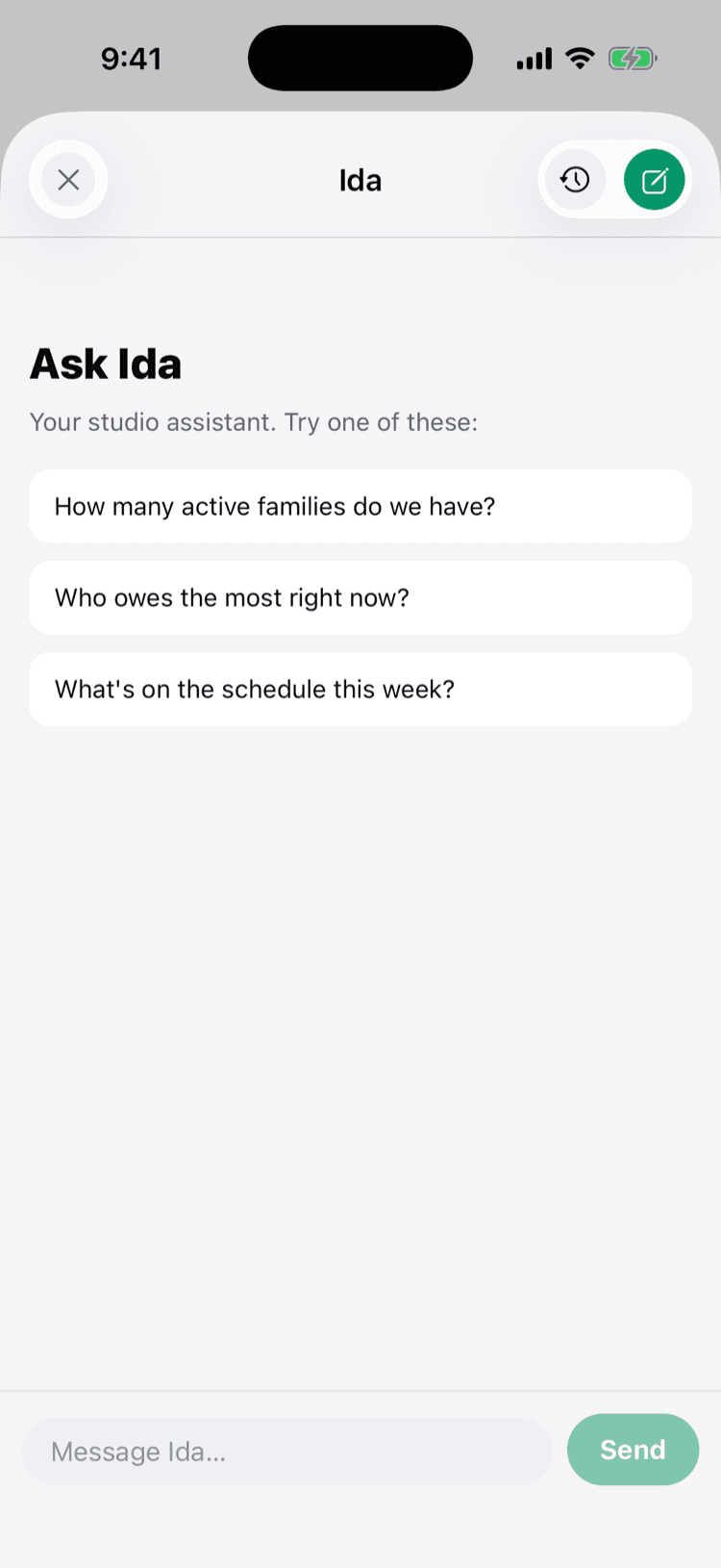
iPhone appAsk Ida has the center spot in the app's tab bar. Tap it to chat — suggested questions and a list of what Ida can do for your role get you started, the clock icon reopens past conversations, the compose icon starts a fresh one, and a swipe down over the conversation tucks the keyboard away. Answers arrive formatted for reading — headings, bold text, lists, and links you can tap. Every answer can be rated with a thumbs up or down (a thumbs-down lets you say what went wrong), and your feedback goes straight to the team.
For families, Ask Ida in the app helps the same way it does on the web: it answers from your studio's shared documents, walks you through using the app step by step, lists the registration policies your family needs to accept (or has already accepted), and shares your studio's web address when you want to use the browser instead.