
Browse all sections
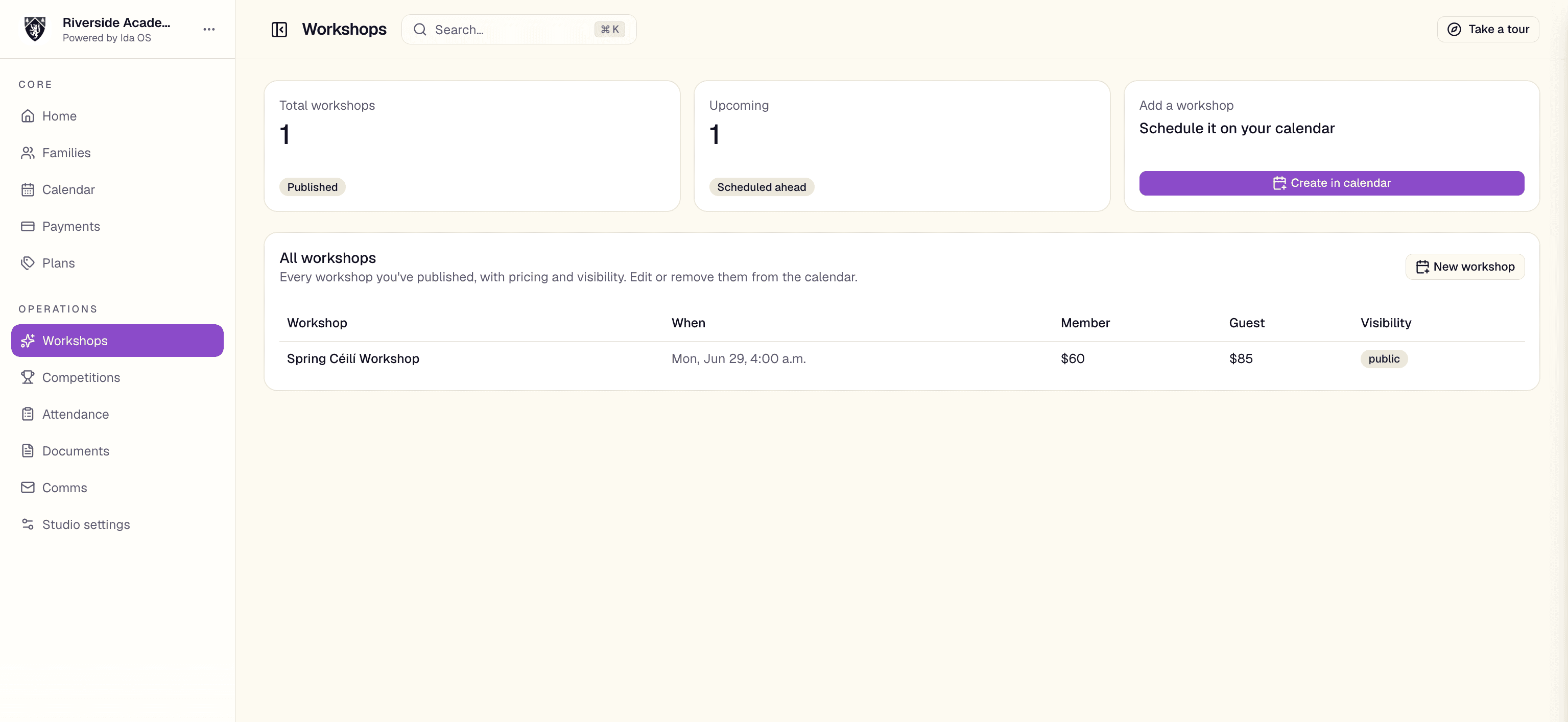
Workshops
/dashboard/programs?kind=eventPrograms is where you sell camps, intensives, drop-ins, class bundles, and monthly tuition — one date or a whole series — to your families. You build each one on Programs, families register from Catalog (the same list, including recurring tuition), and the money lands in the same ledger as everything else. A family already on a monthly program can join the weekly class from Catalog or the calendar without paying that plan again. Every date also becomes a real event on your calendar, so the schedule stays your single source of truth. The Workshop and pack bookings table on Programs lists every dancer — package, dates, fee, and status — and is where you cancel a signup.
Creating a workshop or camp
Choose 'New workshop or camp' and a short guided flow walks you through it — a single workshop date, or many dates grouped into one camp, series, or bundle. Admins can also start straight from the calendar: click an empty slot and pick Workshop as the type, and this same form opens with that date and time already filled in. On the web, the step names across the top are clickable: hop back to an earlier step to change something, or jump ahead — the form checks the steps in between, and if one still needs attention it takes you there and tells you what's missing.
- 1Details — name it, choose Workshop or Camp (or Something else and use your own label), and describe it. A live 'Families see' preview shows the name and label — in your calendar's workshop color — exactly as families will. Tick 'Hide seat count from members' if you would rather families just see Available or Full — registration still stops when a date fills. Optionally set when registration opens and closes: the form shows how long the window stays open, and registration must open before the first date starts and close by the time it begins.
- 2Dates — one date or several, each with its own time, capacity, and (for multi-location studios) location.
- 3Registration — set the fee per dancer for a single date; for multiple dates, decide how families register: everyone attends every date, families choose a set number of dates, or offer both. Each option gets its own name and per-dancer fee (like a 3-Day Pass) — enter 0 to make it free. A choose-your-dates option also asks when the dates are chosen: 'All at checkout' means the family picks every date while buying, and 'One now, rest later' turns the option into a rolling class pass — the dancer picks just their first class at purchase and books the rest one at a time whenever they like, with no further payment. Each option can also carry an optional Public booking price: what a new customer pays when you sell the option on one of your booking forms — leave it blank to charge the member fee there too. A family registering several dancers pays the fee once per dancer, in one combined checkout.
- 4Eligibility — open it to all active dancers, or limit it to selected dancers: anyone matching a chosen level, class roster, or named dancer can register. Class rosters use who is enrolled in that class, and each one shows its schedule day and time so similar classes are easy to tell apart.
- 5Finish with the button that fits: Save draft keeps it hidden from families while you get it ready, and Create and publish (or Publish, when you are editing a draft) opens it up. Once a workshop has registrations it stays published — the form says so — and you close registration or remove it instead.
Note. Every date becomes a real event on your calendar, and one registration puts each of its dancers on the roster of every date it includes. Once the first registration arrives, the dates are locked — the name, pricing, eligibility, and whether seat counts are hidden stay editable.
Tracking and cancelling bookings
For admins, the Workshop and pack bookings table sits on the Programs page, right below the program list — the calendar's Manage in Programs button lands there too — while instructors follow bookings on Workshops. It shows one row per dancer — their package, dates, per-dancer fee, and where the booking stands: awaiting approval, awaiting payment, confirmed, cancelled — or payment window expired, when a family started an online payment but never finished it: the hold lapses on its own, the dates go back on sale, and the family can simply book again with nothing for you to clean up. A rolling class pass shows its use right on the row — how many classes are booked so far and how many uses are left. When siblings were booked together, each dancer still gets their own row; the fee column notes the combined total they share one payment for. Cancelling covers the whole purchase — every dancer booked together comes off every selected date. Cancelling an unpaid booking simply releases its dates; cancelling a paid one never refunds by itself — issue the refund from Payments if money should go back, which also marks the booking refunded. Cancelling a family's booking is an admin action. Prices are admin-only too: package prices and the per-dancer fee column appear only for admins, so instructors can follow who is booked — packages, dates, and status — without seeing what anyone pays, on the web and in the iPhone app alike.
Because these bookings are managed here, their charges are protected on the Payments page: a workshop or camp charge cannot be edited, voided, or deleted there — cancel the booking here instead. Record payment is still available — it cancels any open online payment link before recording the money, and only a full payment confirms the booking; a partial amount is recorded with the rest still owed.
Removing a workshop or camp asks you to cancel its active bookings first. One with booking history is archived rather than erased: it disappears from family signup and its calendar dates are cancelled, while the history stays in your books. Remove lives in the actions menu on each row of the Programs page, alongside Edit — class packs get the same Remove, and a tuition plan's row offers Archive or Reactivate instead — and in the iPhone app behind the ⋯ button on each workshop, camp, or class pack.
On the iPhone app
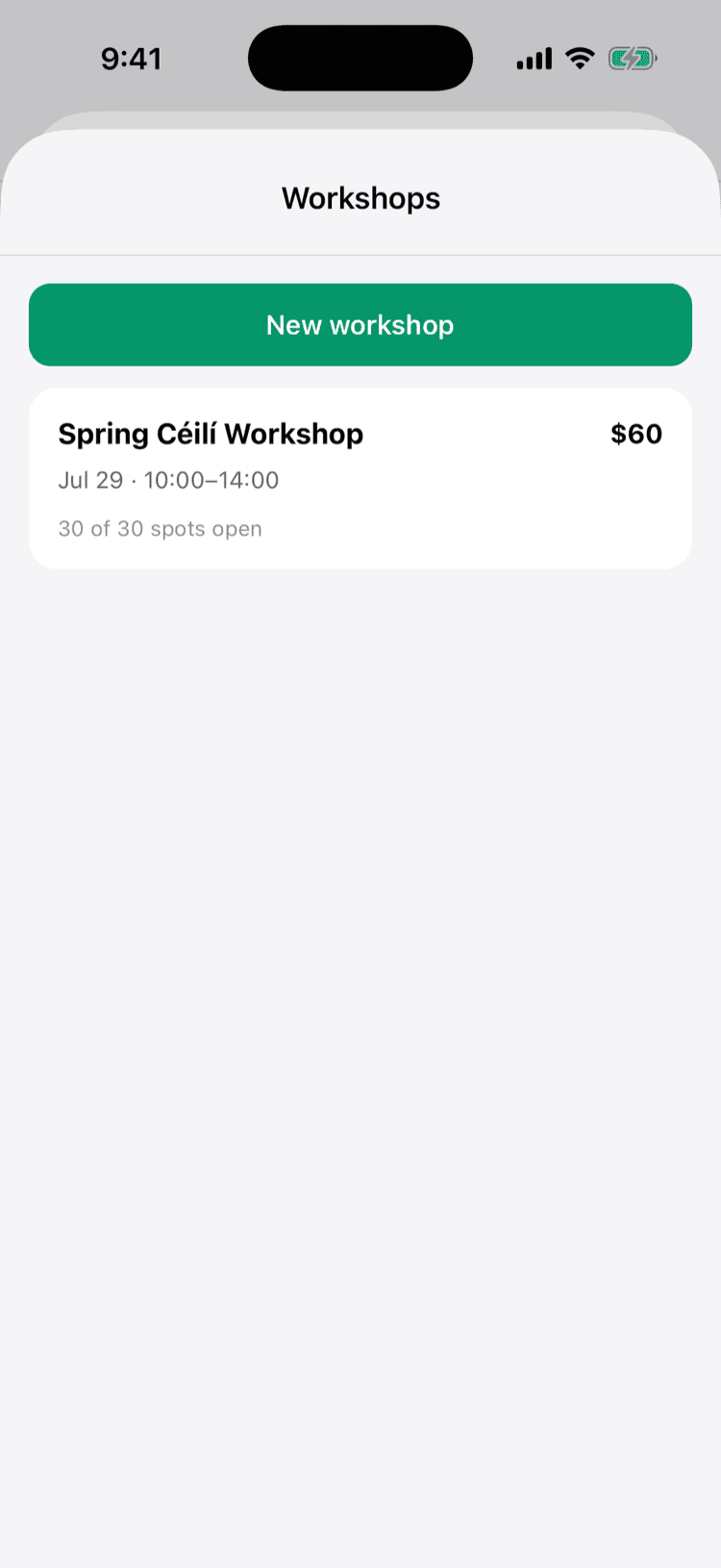
iPhone appWorkshops and camps are fully manageable from your phone. For admins they live on Programs (under More), which lists every one — including drafts — with its status, dates, registration options, and how many bookings it has taken; tap one to open it in the editor, or use the ⋯ button on its row to edit or remove it (the same rules as the web apply: cancel active bookings first, and one with history is archived so your books stay intact). New workshop or camp walks admins through the same four steps as the web — details and the registration window, dates, registration options, and eligibility — and ends with the same Save draft and publish choices. Every date and time is picked with your phone's built-in date and time controls — tap a date to choose it from a calendar, tap a time to set it — with nothing to type, and always in your studio's timezone. The registration window switches on with a toggle for when registration opens and another for when it closes, each starting from a sensible suggestion you can adjust, and each date you add is pre-filled with the day after your latest one, keeping its times and location — so a week-long camp comes together in a few taps. Admins adding a calendar event can pick Workshop as the type to drop straight into this editor — with the date and time they tapped already filled in — and a workshop date on the app's calendar takes an admin to Programs in a tap.